A student can understand a Spanish sentence on a worksheet but freeze when someone speaks Spanish back. Another may know plenty of French vocabulary but struggle to form a complete sentence. Someone else may need German for college but cannot fit another class into an already packed schedule. The Best AI Language Learning Apps for Students can make practice easier by giving students opportunities to speak, review vocabulary, correct mistakes and practice conversations whenever they have time.
The important part is choosing an app based on the skill you actually need to improve. Duolingo is strong for building a daily learning habit, Speak focuses heavily on speaking, Praktika uses AI tutors for conversation, Babbel provides structured courses, and Busuu combines structured learning with AI-powered practice. These products are not interchangeable, so students should compare their learning style, target language, budget and goals before subscribing.
What Students Should Look For in an AI Language App
The best language-learning app isn’t necessarily the one with the largest number of features. Students should first look at whether an app helps with the skills they actually need.
Conversation Practice
If your biggest weakness is speaking, choose an app that requires you to produce language rather than simply recognize the correct answer. AI conversation tutors can give students repeated opportunities to speak without having to arrange a lesson with another person.
For example, instead of selecting an answer from four choices, an AI tutor might ask you what you did over the weekend. You have to create the response yourself, listen to the follow-up question and continue the conversation. That is much closer to real communication than repeatedly selecting multiple-choice answers.
Pronunciation Feedback
Knowing how a word is spelled doesn’t mean you know how to pronounce it. A useful AI language app should give you opportunities to speak aloud and, where supported, provide feedback on pronunciation.
This is particularly useful for students learning languages with unfamiliar sounds. Repeating a difficult word several times and receiving immediate feedback can be more useful than simply listening to a recording.
Vocabulary in Context
Vocabulary is easier to remember when students learn words inside useful phrases. Learning airport, ticket, passport and flight as isolated words is less useful than practicing a sentence such as, “Where is the check-in desk?”
Look for apps that combine vocabulary with conversations, examples, listening exercises and realistic situations.
Grammar Correction
Good grammar feedback should help you understand the mistake instead of simply replacing your sentence. If a student writes, “Yesterday I go to school,” a useful explanation would point out that the sentence refers to the past and should use “went.”
That small explanation helps the student recognize the same mistake later.
Personalized Practice
Beginners shouldn’t receive the same exercises as advanced learners. The better AI language-learning platforms adjust practice according to your level, mistakes, interests and goals.
Personalization is especially useful for students who already understand basic grammar but need more practice with speaking or writing.
Progress Tracking
Students have enough deadlines without having to remember what they studied last week. Progress tracking can show completed lessons, vocabulary reviews, streaks, levels and recurring mistakes.
A good progress system should help answer a simple question: What should I practice next?
AI Language Learning vs. Traditional Language Apps
AI doesn’t automatically make a language app better. Traditional language-learning apps can still be excellent for structured lessons, vocabulary, grammar explanations and progressive courses. AI becomes particularly useful when students need interactive practice and immediate feedback.
| Area | Traditional App | AI-Enhanced App |
|---|---|---|
| Vocabulary | Strong | Strong |
| Structured lessons | Usually strong | Depends on app |
| Conversation | Often limited or scripted | Usually more flexible |
| Pronunciation feedback | Varies | Often interactive |
| Personalized practice | Moderate | Potentially high |
| Immediate corrections | Common in exercises | Common in AI conversations |
| Human interaction | Sometimes available | Usually simulated |
| Flexibility | High | Very high |
| Teacher replacement | No | No |
AI should not be treated as a replacement for a teacher or real conversation partner. A teacher can understand classroom requirements, explain difficult concepts from multiple angles and recognize problems that an automated system may miss.
AI’s biggest advantage is repetition. A student who is nervous about speaking Spanish in front of classmates can practice ten short conversations privately before attempting the same type of conversation with another person.
Best App for Each Language-Learning Goal
The Best AI Language Learning Apps for Students choice changes depending on what you are trying to improve. A student who needs pronunciation practice shouldn’t necessarily choose the same product as someone who needs a structured grammar course.
| Goal | Strong Option | Why |
|---|---|---|
| Daily learning habit | Duolingo | Short lessons and habit-building features |
| Speaking practice | Speak | Strong focus on spoken language |
| AI conversation tutor | Praktika | AI tutors and personalized conversations |
| Large language selection | Talkpal | Supports more than 130 languages |
| Structured lessons | Babbel | Course-based learning |
| Everyday vocabulary | Memrise | Native-speaker content and AI practice |
| Structured course + AI | Busuu | Courses with AI features |
| Custom practice | ChatGPT | Flexible voice and role-play |
Best for Speaking Practice: Speak
Speak is a strong choice for students whose main problem is not knowing enough opportunities to speak. The platform focuses on practical speaking, AI conversations and feedback on pronunciation and phrasing. For English speakers, Speak currently offers courses in Spanish, French, Korean, Japanese, Italian and Simplified Chinese.
Its approach makes sense for students who already understand basic vocabulary but hesitate when they have to produce a sentence. The app currently provides a seven-day free trial rather than a permanent free plan, while paid Premium and Premium Plus plans provide broader access. Pricing can vary depending on the subscription period and location.
Best for an AI Tutor: Praktika
Praktika is built around AI tutors that students can communicate with through conversations. The platform provides personalized study plans and practice based on the learner’s goals, interests and progress. It can provide feedback related to pronunciation, grammar and word choice.
This makes it particularly useful for students who want repeated speaking practice without arranging a lesson every time. A student preparing for a semester abroad could use an AI tutor to practice airport conversations, ordering food, meeting classmates, asking for directions and discussing daily routines.
Best for a Large Language Selection: Talkpal
Talkpal is designed as an AI language tutor and currently lists more than 130 languages. Students can communicate through writing or speaking and practice simulated real-world situations. The platform also provides features such as pronunciation assessment, personalized learning and progress tracking.
Talkpal has a free Basic plan with limited daily access, while Premium plans provide broader usage. Its large language selection makes it particularly interesting for students learning languages that aren’t deeply supported by every mainstream language-learning platform.
Best for Structured Learning: Babbel
Babbel is a stronger choice for students who want a structured language course rather than relying mainly on open-ended AI conversation. Its courses for English speakers cover 13 languages and include listening, speaking, writing, grammar and real-life dialogue practice.
Babbel also provides AI-powered conversation practice through Babbel Speak. Students can therefore combine a structured course with interactive speaking practice. Babbel offers limited free access, including the ability to try the first lesson of its courses, while full course access requires a paid subscription.
Best for a Free Daily Habit: Duolingo
Duolingo remains one of the easiest options for students who need motivation to study consistently. Its short lessons, progress system, streaks and reminders make it simple to build a daily routine.
The free version provides the core learning experience, while Super and Max subscriptions add additional features. Max includes more advanced AI-powered features such as Roleplay and Video Call.
For a student who struggles to study consistently, the ability to complete a short lesson every day can be more valuable than having access to dozens of advanced features that rarely get used.
Main App Comparison
The following comparison gives a quick overview of the Best AI Language Learning Apps for Students before looking at their individual strengths.
| App | Best For | Languages | AI Features | Free Option |
|---|---|---|---|---|
| Duolingo | Daily learning | Large selection | Personalized practice and AI conversation on Max | Yes |
| Speak | Speaking | 6 for English speakers | AI Tutor and speaking feedback | 7-day trial |
| Praktika | AI tutoring | Multiple | AI tutors and personalized practice | Availability varies |
| Talkpal | Language variety | 130+ | Conversation and pronunciation practice | Yes |
| Babbel | Structured learning | 13 for English speakers | Babbel Speak | Limited free access |
| Memrise | Natural vocabulary | Multiple | AI conversation and smart review | Yes |
| Busuu | Structured + AI practice | 14 | AI Conversations on Premium Plus | Yes |
| ChatGPT | Custom practice | User-directed | Voice, role-play and explanations | Yes |
The Apps Explained
Duolingo
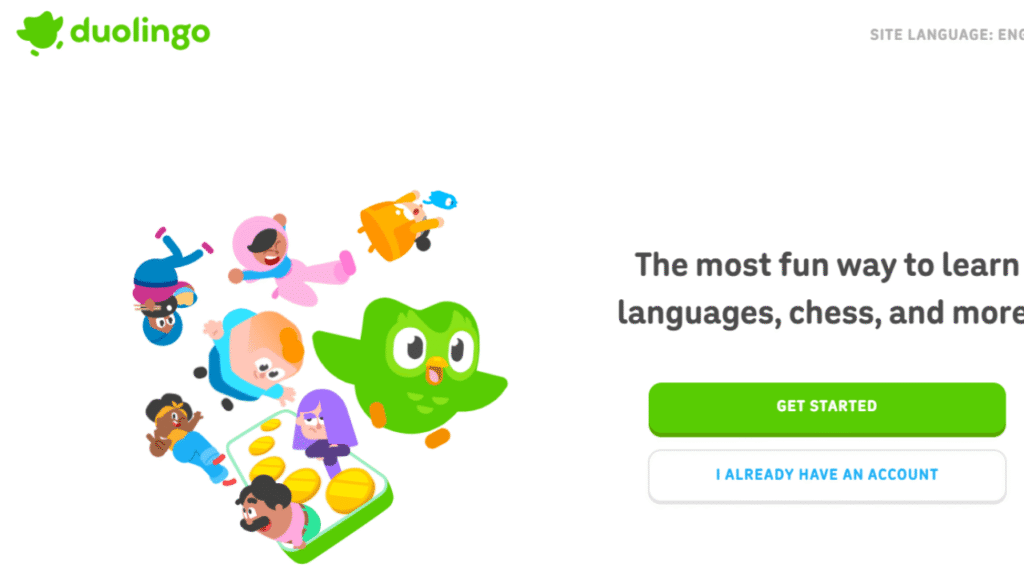
Duolingo combines language lessons with game-like progression, streaks, reminders and personalized practice. It is particularly effective for students who need motivation to study regularly rather than students who already have a strong study routine.
Its free version makes it accessible to students who don’t want to pay for another subscription. Paid Super and Max plans add additional features, with Max providing advanced AI features such as Roleplay and Video Call.
Duolingo offers a large selection of languages, although course depth and availability vary by language. Its biggest strength is accessibility: a student can open the app, complete a short lesson and continue studying without needing to build a complicated study system.
Best for: Students who struggle with consistency.
Strengths: Free access, large language selection, beginner-friendly lessons and strong habit-building features.
Limitations: Students seeking advanced speaking practice may eventually need another resource, and the game-like structure doesn’t replace real conversations.
Student example: A high school student learning Spanish could spend 15 minutes every morning on Duolingo and use a dedicated speaking app twice a week for longer conversations.
Speak
Speak takes a speaking-first approach. Rather than focusing mainly on selecting answers, it encourages students to produce spoken language and practice conversations with an AI tutor.
For English speakers, the platform currently offers Spanish, French, Korean, Japanese, Italian and Simplified Chinese. Its AI features include conversation practice, speaking feedback and pronunciation-related feedback.
Speak currently offers a seven-day free trial rather than a permanent free plan. Paid plans provide additional access, with pricing varying according to location and subscription period.
Best for: Students who understand a language but don’t feel comfortable speaking it.
Strengths: Strong speaking focus, practical conversations, pronunciation feedback and personalized practice.
Limitations: No permanent full-access free plan, and its language selection is smaller than Talkpal.
Student example: A college student who has studied Spanish for two years but rarely speaks could use Speak for 15 minutes every evening and gradually increase conversation difficulty.
Praktika
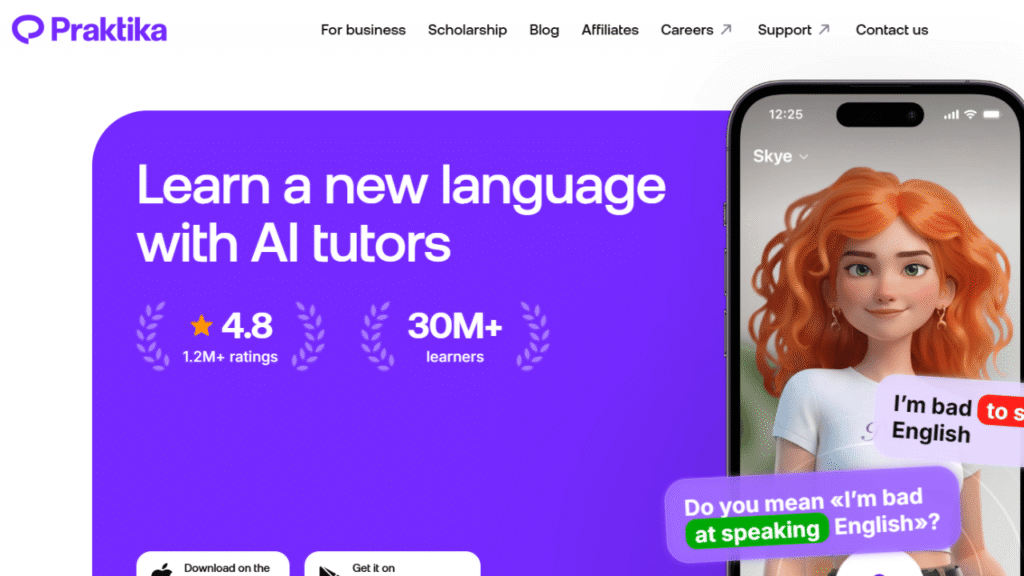
Praktika focuses on AI tutors and conversational practice. Students can interact with AI characters, practice different scenarios and receive feedback related to pronunciation, grammar and word choice.
The platform is useful for students who need a low-pressure environment where they can make mistakes repeatedly. Someone preparing for an exchange program could practice situations such as introducing themselves to classmates, asking for directions, ordering food or discussing their academic interests.
Free access and pricing can vary according to the current offer, platform and subscription arrangement, so students should check the plan presented when signing up.
Best for: Students who want repeated AI conversation practice.
Strengths: AI tutors, personalized practice, conversation scenarios and immediate feedback.
Limitations: AI conversation cannot fully reproduce human interaction, and students may still need a separate resource for formal grammar study.
Talkpal
Talkpal is an AI language tutor with a particularly broad language selection. The platform currently lists more than 130 languages and provides speaking and writing practice, simulated situations, pronunciation assessment and personalized learning features.
Its Basic plan provides limited free access, while Premium plans provide more extensive usage. The free plan is useful for students who want to test whether AI conversation practice works for them before paying.
Best for: Students who need a large selection of languages.
Strengths: Broad language support, conversation practice, pronunciation assessment and a genuine free tier.
Limitations: Free usage is limited, and the depth of learning may differ between languages.
Student example: A student preparing for an exchange program in Sweden could use Talkpal for daily Swedish conversation practice while using a textbook for formal grammar.
Babbel
Babbel is built around structured language courses rather than unrestricted AI conversations. Its courses for English speakers cover 13 languages and combine grammar, vocabulary, listening, speaking and writing.
Babbel Speak adds AI-powered conversation practice, giving students an opportunity to use what they have learned in more interactive situations.
Babbel provides limited free access, including the ability to try the first lesson of each course. Full course access requires a subscription, and pricing depends on factors such as subscription length and location.
Best for: Students who want a clear curriculum.
Strengths: Structured courses, grammar instruction, short lessons and real-life dialogue.
Limitations: Full access requires payment, and its language selection is smaller than Talkpal.
Student example: A college student enrolled in an introductory German course could use Babbel as a structured supplement while using AI conversations for additional speaking practice.
Memrise
Memrise combines vocabulary learning with native-speaker video and AI conversation practice. This can help students become familiar with everyday expressions rather than only textbook language.
Its AI features provide conversation opportunities, while its review system helps reinforce vocabulary.
Memrise has free access alongside paid features. Students who want more advanced functionality can upgrade to a paid plan.
Best for: Students who want everyday vocabulary and exposure to natural speech.
Strengths: Native-speaker videos, practical vocabulary, AI conversation and free access.
Limitations: Students looking for a highly structured academic curriculum may prefer Babbel or Busuu.
Student example: A student preparing for a trip to France could learn everyday expressions through native-speaker clips and then use AI conversation practice to use those expressions.
Busuu
Busuu combines structured courses, grammar and vocabulary practice with community feedback. Its Premium Plus plan adds AI-powered conversation features, pronunciation feedback and Mistake Repair.
Busuu currently offers courses in 14 languages. The free plan provides access to essential course content and selected features, while Premium and Premium Plus provide additional functionality.
Best for: Students who want structured learning with AI speaking practice.
Strengths: Structured curriculum, community features, grammar practice and AI conversation on Premium Plus.
Limitations: The strongest AI features require Premium Plus, and feature availability can vary by language.
Student example: A student studying French could complete structured lessons during the week and use AI Conversations to practice speaking before a class presentation.
ChatGPT
ChatGPT is different from the dedicated language-learning apps in this list. It is a general AI assistant rather than a language-learning platform, but its flexibility makes it useful for custom language practice.
Students can use it for role-play, grammar explanations, writing correction, vocabulary exercises and voice conversations. A useful instruction might be: “Act as my Spanish conversation tutor. Speak at an A2 level. Ask one question at a time and let me finish before correcting me. At the end, show me my three most important mistakes.”
The free plan provides access with usage limits, while paid plans provide additional capabilities depending on the current plan.
Best for: Students who want customized language practice.
Strengths: Flexible conversations, role-play, grammar explanations, writing practice and custom exercises.
Limitations: It isn’t a dedicated language-learning curriculum, and students need to create their own structure.
Speaking and Pronunciation Comparison
Speaking is where the differences between these products become especially important.
| App | Conversation | Pronunciation | Structured Lessons | Best Use |
|---|---|---|---|---|
| Speak | Excellent | Yes | Yes | Speaking confidence |
| Praktika | Excellent | Yes | Yes | AI tutor conversations |
| Talkpal | Excellent | Yes | Yes | Language variety |
| Duolingo | Available on Max | Speaking features | Excellent | Habit + speaking |
| Busuu | Available on Premium Plus | Yes | Excellent | Course + conversation |
| Babbel | Available through Speak | Speaking practice | Excellent | Structured learning |
| Memrise | Yes | AI practice | Moderate | Natural vocabulary |
| ChatGPT | Highly flexible | Can provide feedback | Custom | Personalized practice |
If pronunciation is your biggest weakness, don’t choose an app simply because it advertises AI. Test whether you can actually speak, receive feedback, repeat the sentence and improve.
A 30-Day AI Language Study Plan
A language app works much better when it is part of a routine. Instead of opening the app randomly, give each week a specific purpose.
Week 1: Vocabulary and Basic Phrases
Spend about 25–30 minutes each day learning 10–15 useful words, practicing several complete phrases, listening to native pronunciation and reviewing vocabulary from the previous day.
Avoid trying to memorize huge lists. Instead of learning airport, ticket, passport and flight separately, practice a sentence such as “Where is the check-in desk?” This gives the words context and makes them easier to retrieve later.
Week 2: Grammar and Listening
Spend around 10 minutes reviewing vocabulary, 10 minutes studying grammar, 10 minutes listening and five minutes speaking.
Ask your AI tutor to explain recurring mistakes in simple language. If you repeatedly confuse French masculine and feminine nouns, ask the app to create practice specifically around that weakness instead of continuing with topics you already understand.
Week 3: Speaking and Conversation
This week should focus heavily on producing language. Spend at least 10–15 minutes speaking every day.
Practice situations such as ordering food, introducing yourself, asking for directions, discussing your classes, describing your weekend, talking about hobbies and giving opinions.
Don’t read the answer first. Speak from memory, make mistakes and then review the correction.
Week 4: Writing and Real-World Practice
Start combining speaking, reading and writing.
Write short messages, diary entries, summaries, opinions or paragraphs about your classes. Ask your AI tool to identify grammar mistakes, unnatural expressions and vocabulary you repeatedly overuse.
Then rewrite the paragraph yourself. If the AI does all of the rewriting, you’re watching the language improve rather than actually practicing it.
How to Use AI Without Becoming Dependent on It
AI should increase practice, not remove the thinking required to learn.
Speak Before Asking for Help
If you forget a word, try describing it first. Instead of immediately asking for the Spanish word for “umbrella,” you might say, “The thing you use when it rains.”
That forces your brain to search for language instead of immediately relying on translation.
Keep a Mistake List
Divide recurring problems into three categories: grammar, vocabulary and pronunciation. If you make the same mistake repeatedly, that mistake should become one of your next study priorities.
Ask for Delayed Correction
During conversation practice, tell your AI tutor to let you finish speaking before correcting you. After your response, ask it to show your three most important mistakes.
This keeps the conversation more natural while still giving you useful feedback.
Use Spaced Review
Don’t assume that learning a word once means you know it permanently. Review difficult vocabulary after one day, three days, one week and two weeks.
If vocabulary memorization is your main weakness, our Best AI Flashcard Generators for Students guide can help you find a separate tool for spaced-repetition practice.
Keep Some Human Interaction
AI conversation is convenient, but real people introduce accents, interruptions, unexpected questions and cultural context.
Talk to classmates, teachers, exchange partners or native speakers whenever possible. AI gives you repetition; human conversations give you unpredictability.
Common Mistakes Students Make
Translating Everything
Translation is useful when you’re stuck, but it shouldn’t become your default method of thinking. As your ability improves, try to understand simple sentences directly in the target language.
Memorizing Without Context
A vocabulary list can make you feel productive without helping you communicate. Learn words through sentences, conversations and realistic situations.
Avoiding Speaking
Students often spend weeks reading and tapping answers because speaking feels uncomfortable. Start speaking early, even if your sentences aren’t perfect.
Accepting Every AI Correction
AI systems can misunderstand context or provide an explanation that sounds convincing but isn’t correct. For important academic questions, verify difficult grammar explanations with your teacher, textbook or another reliable resource.
Ignoring Pronunciation
Knowing how a word looks doesn’t guarantee that someone will understand you when you say it. Practice difficult sounds aloud and repeat words that consistently cause problems.
Studying Inconsistently
Thirty minutes every day is usually more useful than three hours once a week. The best app is the one you can realistically keep using.
Best Free Options
Students should distinguish between a free plan, a free trial and limited free access.
| App | Free Access | Type |
|---|---|---|
| Duolingo | Yes | Free plan |
| Busuu | Yes | Free plan |
| Memrise | Yes | Free plan |
| Talkpal | Yes | Free plan with limits |
| Babbel | Limited | Limited free access |
| Speak | 7 days | Free trial |
| Praktika | Varies | Depends on current access |
Duolingo, Busuu, Memrise and Talkpal provide genuine free starting options. Babbel provides limited access for trying its courses, while Speak currently provides a seven-day trial rather than a permanent free plan.
For students on a tight budget, it makes sense to start with a genuine free tier before paying for a specialized speaking platform. Students comparing free resources across other academic tasks can also look at our Best Free AI Tools for Students guide.
Free Plan vs. Free Trial
A free plan allows continued use without paying, although certain features may be restricted. Duolingo, Busuu, Memrise and Talkpal are examples of services with free access.
A free trial is temporary access to paid features. Speak currently offers a seven-day trial.
Limited free access sits somewhere between the two. A service may allow students to try selected lessons or features without offering full ongoing access.
This distinction matters when comparing student budgets. A seven-day trial should not be described as a completely free language-learning app.
How to Build an AI Language Study Routine
A simple routine is easier to maintain than a complicated system.
10 Minutes — Vocabulary
Review difficult words first, then learn a small number of new words. Focus on words you can actually use in conversation.
10 Minutes — Listening
Listen to a dialogue, lesson, native-speaker clip or short piece of content in your target language.
10 Minutes — Conversation
Speak with an AI tutor about one practical topic. Try to answer without reading a prepared response.
10 Minutes — Writing
Write five to ten sentences about your day, classes, hobbies or another familiar topic.
5 Minutes — Review
Write down your three biggest mistakes and review them before your next session.
If you only have 20 minutes, reduce each section rather than skipping the routine entirely. Students who need help organizing recurring study sessions can also use our Best AI Study Planner Apps for Students guide to build language practice into a weekly schedule.
Best App by Student Goal
| Student Goal | Recommended App | Reason |
|---|---|---|
| Learn consistently | Duolingo | Strong habit-building design |
| Speak more confidently | Speak | Speaking is the central focus |
| Practice with an AI tutor | Praktika | Personalized tutor experience |
| Learn a less common language | Talkpal | Very broad language selection |
| Build grammar foundations | Babbel | Structured courses |
| Learn everyday vocabulary | Memrise | Native-speaker content |
| Combine curriculum and AI | Busuu | Structured lessons plus AI |
| Build custom practice | ChatGPT | Flexible role-play and voice |
| Study with free access | Duolingo / Busuu / Memrise | Genuine free starting options |
This is why Best AI Language Learning Apps for Students shouldn’t be treated as a simple ranking from first place to last place. Each product solves a different learning problem.
Frequently Asked Questions
Are AI language learning apps good for beginners?
Yes. Beginners can benefit from short lessons, controlled conversations, pronunciation practice and immediate explanations. Choose an app that lets you begin with manageable phrases and gradually increase difficulty.
Can an AI app make me fluent?
No app can guarantee fluency. Progress depends on practice time, your starting level, the quality of your study and how often you actually use the language outside the app.
AI can provide more practice opportunities, but it cannot guarantee a particular level of proficiency.
Which AI app is best for speaking practice?
Speak, Praktika and Talkpal are particularly focused on AI conversation. Duolingo Max and Busuu Premium Plus also provide AI conversation features.
Are free AI language apps enough for school?
They can be enough for basic vocabulary, grammar practice and regular study. Students preparing for advanced courses, oral exams or university-level language work may need additional resources.
Which app is best for pronunciation?
Look for an app that analyzes spoken input rather than simply playing audio. Speak, Praktika, Talkpal and Busuu Premium Plus all provide pronunciation-related features.
Can I use ChatGPT as a language tutor?
Yes. Students can use voice conversations for role-play, grammar explanations, vocabulary practice and conversation exercises. However, ChatGPT is a general AI assistant rather than a dedicated language-learning curriculum.
Is Duolingo completely free?
Duolingo offers a free learning experience, while Super and Max subscriptions add additional features. Max provides more advanced AI-powered conversation features.
Is Speak free?
Speak currently offers a seven-day free trial. It does not provide permanent full access after the trial without a paid subscription.
Does Babbel have a free plan?
Babbel allows users to register for free and try selected course content, including the first lesson of its courses. Full course access requires a paid subscription.
Can AI correct my grammar while I speak?
Some AI tutors provide corrections during or after conversations. The exact timing and depth of feedback depends on the product. Speak, Praktika, Talkpal and other AI-focused platforms are useful for this type of practice.
Should students use multiple language apps?
Usually, one main app is enough when you’re starting. Add another app only when it solves a specific weakness.
For example, you might use Babbel for structured lessons and Speak for additional conversation practice. That is more useful than downloading six apps and barely using any of them.
Can AI replace a language teacher?
No. AI can provide repetition, explanations and conversation practice, but teachers provide human interaction, classroom context and broader assessment.
Which app is best for college students?
It depends on the course and your learning goal. Babbel or Busuu can work well for students who want structured progression, while Speak or Praktika may be better when speaking is the main weakness.
Can I use AI for language exam preparation?
Yes, but match your practice to the exam. AI can help with speaking simulations, vocabulary, writing feedback, role-play and grammar practice. Use official exam materials as well to understand the actual format and requirements.
How long should students study a language each day?
Twenty to 45 minutes is a practical starting point for many students. Increase the time when an exam or study-abroad deadline requires it, but avoid creating a schedule that is so demanding you stop following it.
Final Recommendations
The Best AI Language Learning Apps for Students choice depends on the skill you want to develop.
Choose Duolingo if consistency is your biggest problem. Its free access, short lessons and habit-building design make it easy to keep language practice in your daily routine.
Choose Speak if you already know basic vocabulary but need to become more comfortable speaking. Its approach is heavily focused on producing language and practicing conversations with AI.
Choose Praktika if you want an AI conversation tutor that is available whenever you want to practice. Its tutor-based approach makes it useful for students who need repeated speaking opportunities.
Choose Talkpal if language availability is your priority. Its current platform lists more than 130 languages and provides AI conversation and pronunciation-related tools.
Choose Babbel if you want a structured course with clear progression and strong grammar foundations. Its lessons cover speaking, listening, writing and grammar rather than relying entirely on AI chat.
Choose Memrise if you want everyday vocabulary, native-speaker content and AI conversation practice.
Choose Busuu if you want structured courses alongside AI conversation and pronunciation features available through Premium Plus.
Choose ChatGPT if you want highly customized practice. It works particularly well for role-playing conversations, explaining grammar and practicing speaking through voice, but you need to create the learning structure yourself.
The biggest mistake is spending weeks comparing apps without actually practicing the language. Pick one, set a daily target, speak out loud, track recurring mistakes and gradually increase the difficulty.
The strongest Best AI Language Learning Apps for Students experience isn’t necessarily the app with the longest feature list. It’s the one that gets you practicing consistently and helps you improve the specific language skills you need.
Featured Image ALT Text
Best AI Language Learning Apps for Students showing a student practicing a foreign language with AI conversation tools
Suggested Screenshot ALT Texts
- Duolingo: Duolingo language learning app showing a student completing a language lesson and practicing vocabulary
- Speak: Speak language learning app showing AI conversation practice and speaking feedback
- Praktika: Praktika AI language tutor showing a student practicing a spoken conversation
- Talkpal: Talkpal AI language tutor showing language conversation and pronunciation practice
- Babbel: Babbel language learning app showing a structured language lesson with vocabulary and speaking exercises
- Memrise: Memrise language learning app showing native-speaker language content and AI practice
- Busuu: Busuu language learning app showing a structured language lesson and progress features
- ChatGPT: ChatGPT voice conversation being used for customized language speaking practice